SOARLAB Space Open-Source Stack (Late 2026)
SOARLAB's open-source robotics stack spanning perception (D²SLAM 2.0), orbital physics simulation (SOARSpaceLab), and agent-oriented mechanical design (SOARWorkBench), planned for release in late 2026.
Open Source · Late 2026
SOARLAB Space Open-Source Stack
An open, full-stack robotics engineering suite from SOARLAB (Flying General Intelligence Lab), School of Intelligence Science and Technology, Nanjing University. Spanning onboard collaborative perception, orbital physics simulation & VR teleoperation, and agent-oriented parametric mechanical design, all three repositories are scheduled for public open-source release in late 2026.
End-to-End Engineering Loop
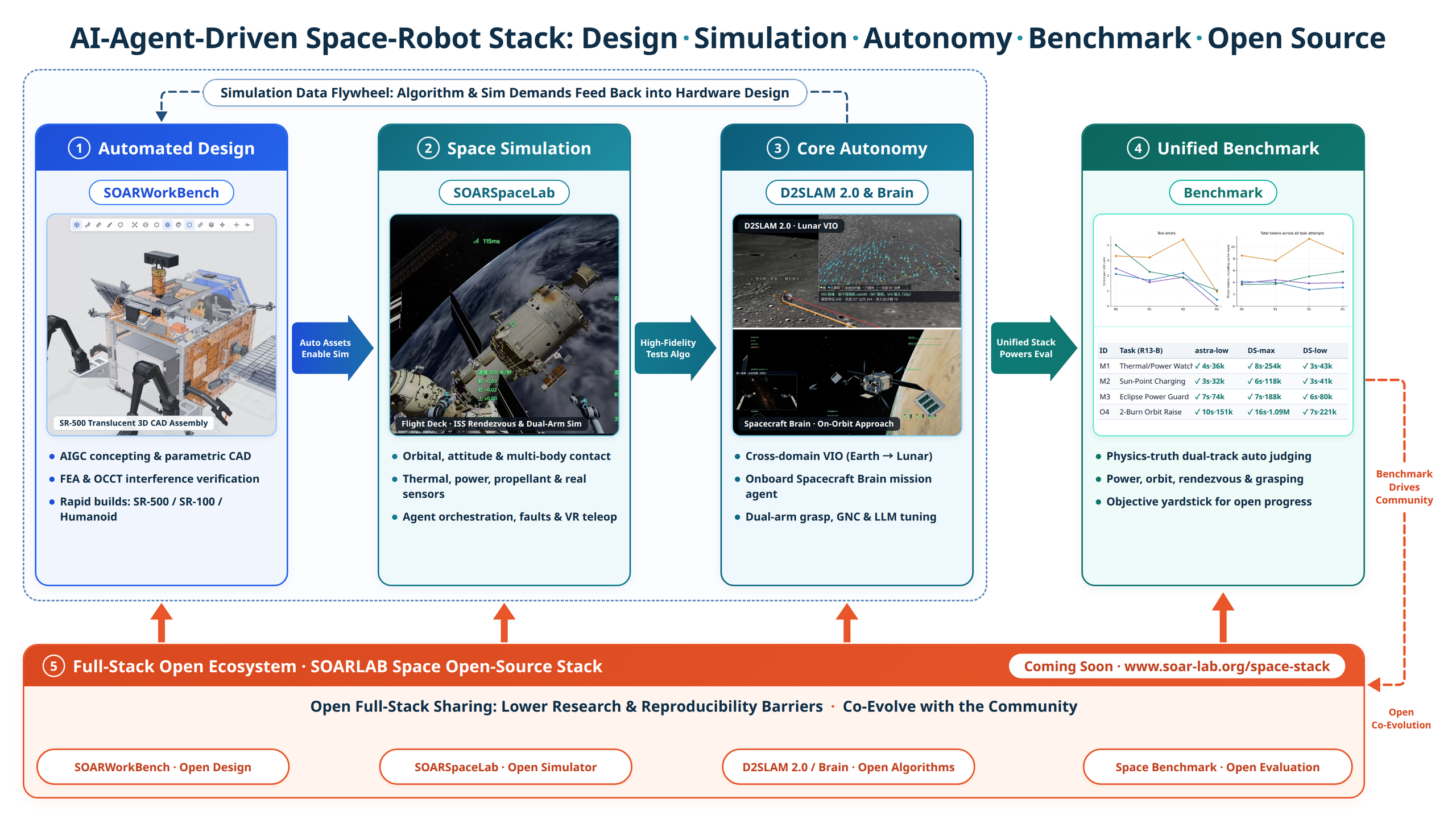
Each system works standalone and connects cleanly into a unified Design → Simulation → Onboard Perception workflow:
01 · Mechanical Design
SOARWorkBench
Persistent Design Tree, AIGC concept iteration, parametric CAD, and deterministic OCCT checks—exporting both manufacturing packs and paired full-joint / rigid-body LoD simulation models.
02 · Simulation & Teleop
SOARSpaceLab
Native C++20 orbital ephemeris & PhysX contact dynamics, isolated RobotIO algorithm processes, and RTX / PICO VR teleoperation for in-orbit servicing evaluation and data recording.
03 · Autonomous Perception
D²SLAM 2.0
ROS 2 Jazzy visual-inertial-GNSS swarm SLAM with dedicated planetary/lunar powered-descent VIO optimizations (central gravity, star-tracker fusion, online extrinsic priors).
Three Open-Source Pillars
Pillar 01 · Perception
Open Source · Late 2026D2SLAM 2.0
Stars loading...
The next-generation ROS 2 successor to D2SLAM (IEEE Transactions on Robotics, 2024), combining decentralized aerial-swarm visual-inertial-GNSS SLAM with dedicated planetary-navigation optimizations for map-free lunar powered-descent VIO.
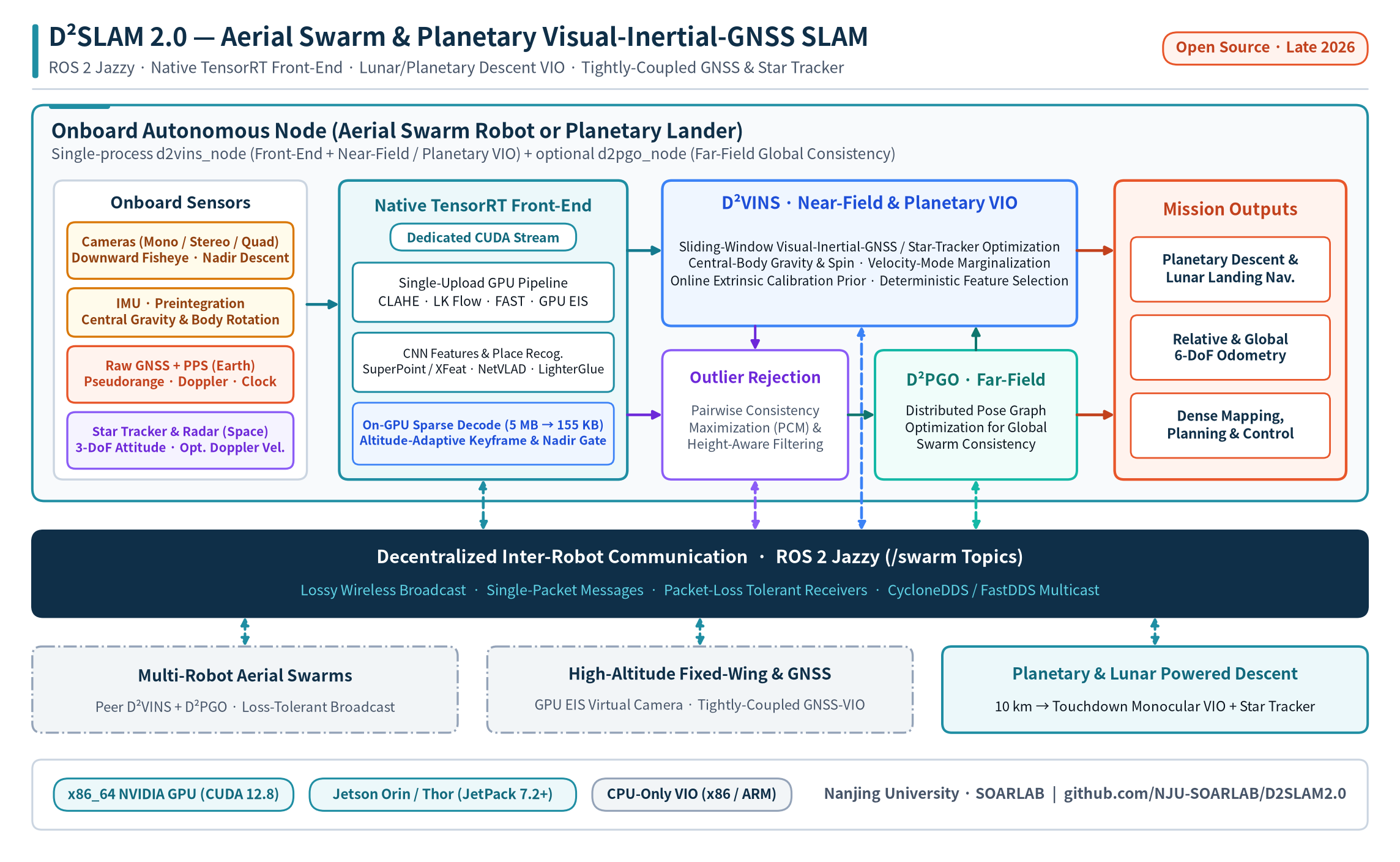
- Planetary & Lunar Powered-Descent VIO: Replaces flat-Earth gravity with central-body spherical gravity and planetary rotation, tightly fusing star-tracker attitude (
StarTrackerFactor) with a 3-DoF alignment state, velocity-mode marginalization, nadir gating, online camera-IMU extrinsic estimation with calibration priors (ExtrinsicPriorFactor), and optional Doppler radar velocity factors. Across 8 SOARSpaceLab Tranquility Base descent trajectories (10 km → touchdown, ~113 km track, industrial MEMS IMU + star tracker, map-free / no loop closure), touchdown drift reaches 56 ± 16 m and 0.02 m/s vs. 309 ± 39 m / 0.87 m/s for star-tracker + pure INS under the same sensor error model. - High-Altitude Downward EIS & Adaptive Keyframes: Supports downward monocular fisheye cameras with GPU-accelerated electronic image stabilization (EIS), landmark-based ground-height estimation, altitude-adaptive keyframe selection, and height-aware loop filtering.
- Native ROS 2 Jazzy & Tightly-Coupled GNSS-VIO: Full migration off ROS 1 / LCM with single-packet, packet-loss-tolerant wireless multicast
/swarmtopics, plus sliding-window raw GNSS pseudorange/Doppler fusion and PPS synchronization for terrestrial missions. - Native TensorRT Front-End & Multi-Platform Docker: SuperPoint / XFeat, NetVLAD, and optional LighterGlue on native TensorRT with single-upload GPU processing and sparse on-GPU decoding (5 MB → 155 KB/frame), cutting EuRoC runtime (37 → 25 ms/frame) across x86_64 GPU, Jetson Orin/Thor, and CPU-only VIO images.
Pillar 02 · Simulation
Open Source · Late 2026SOARSpaceLab
Stars loading...
A space-robot simulation and teleoperation platform built on NVIDIA Isaac Sim / PhysX. A native C++20 simulation core unifies solar-system ephemerides, free-flying dual-arm manipulation, operable spacecraft, isolated algorithm processes, and VR teleoperation.
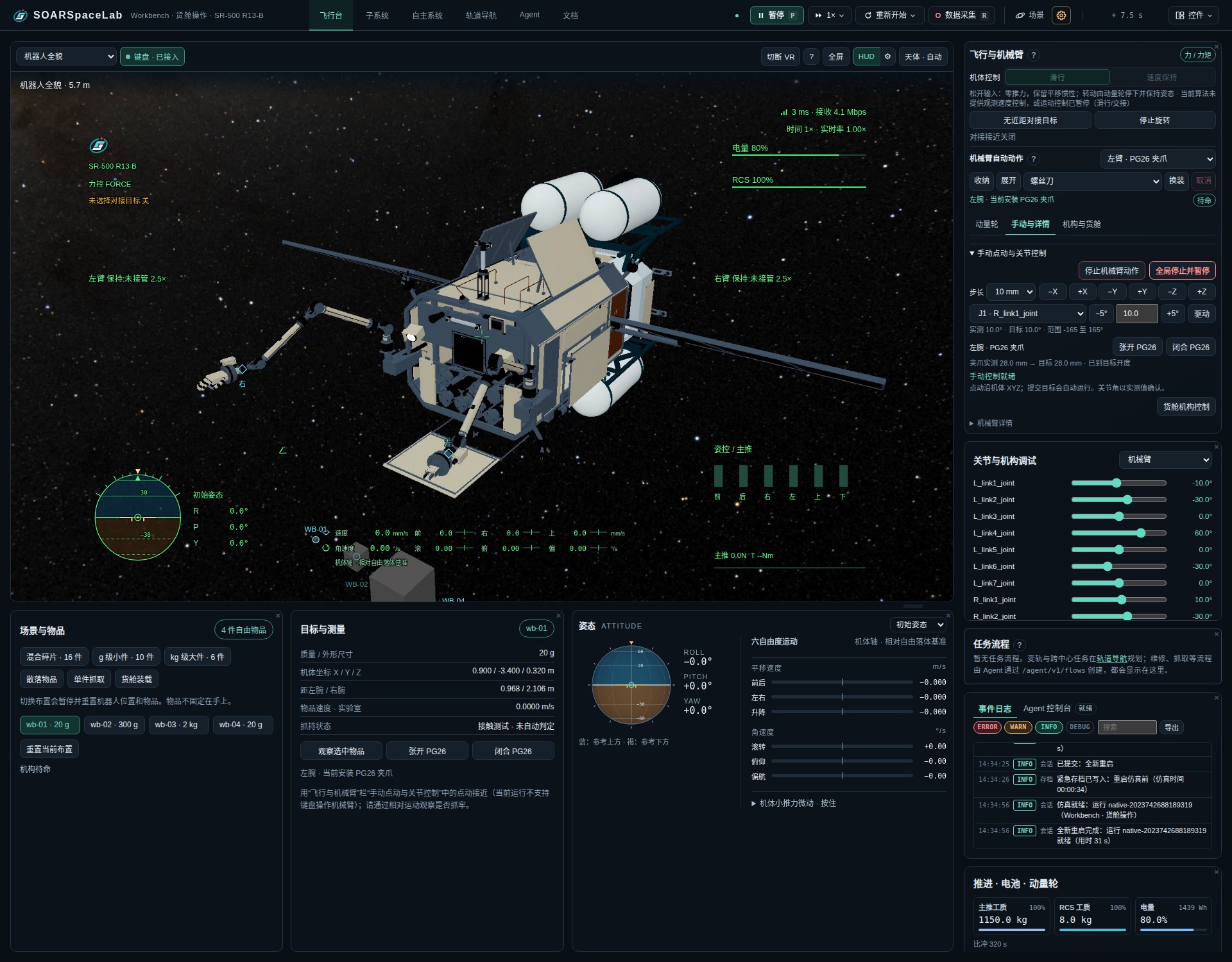
- Unified Orbital & Contact Physics: 34 natural bodies driven by SPICE ephemerides, decoupling double-precision global orbital coordinates from local PhysX contact solving with automatic full-physics / rigid-body LoD switching.
- Native C++20 Simulation Core: World clock, gravity and contact, propulsion and reaction wheels, propellant/mass bookkeeping, and electro-thermal networks execute in C++ at 30 / 50 / 100 Hz.
- Free-Flying Dual-Arm Robots & Operable Spacecraft: Supports the SR-500 dual-arm robot family (automatic arm stow/deploy, physical tool exchange, work lights, thermal management) and modular operable spacecraft including the ISS.
- RobotIO Algorithm Processes & VR Teleoperation: Connects perception, planning, control, PX4 SITL, and onboard agents over unified observations and command leases, paired with RTX rendering, NVENC HEVC streaming, a web Dashboard, and PICO VR teleoperation.
Pillar 03 · Mechanical Design
Open Source · Late 2026SOARWorkBench
Stars loading...
An agent-oriented parametric CAD and mechanical design workbench for complex multi-hundred-part robots. Built around a persistent Design Tree, it couples AIGC concept exploration, single-track parametric CAD, a deterministic engineering Harness, and human-in-the-loop 3D review.
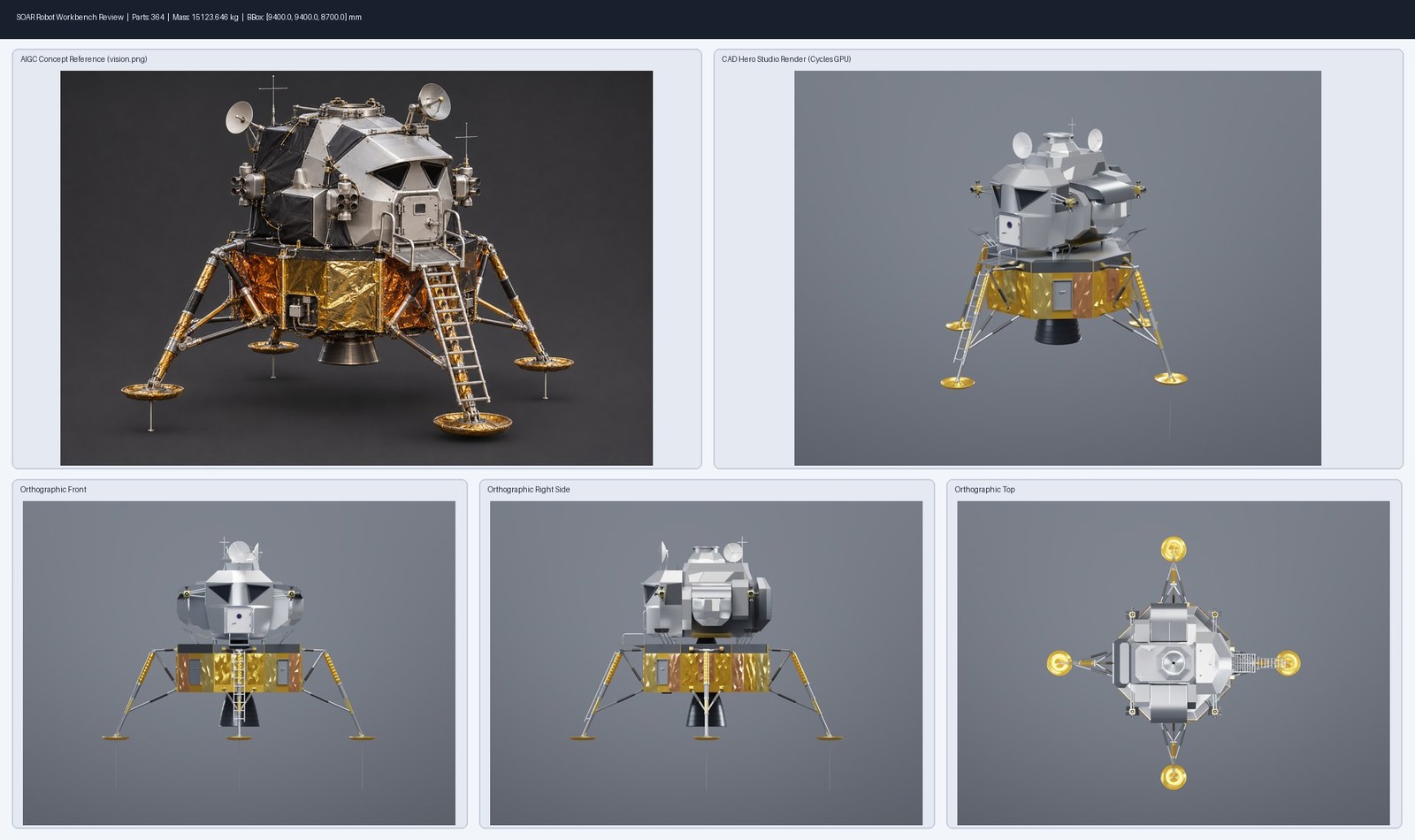
- Persistent Design Tree & L1–L4 Stage Gating: Organizes whole robot → subsystems → sub-assemblies → parts with multi-level relative coordinate skeletons, mass/envelope budgets, BREP/STEP caches, and progressive maturity gates.
- Three Nested Design Loops: Integrates an AIGC visual concept loop (with locked COTS masks and matched-viewpoint review boards), a sub-assembly Agent Harness loop, and whole-robot integration rounds.
- Deterministic OCCT Verification (
swb go): Single-command feedback combining GLB build, mass/CoM summary, and 8 deterministic checks (watertight solids, mass budget, exact OCCT Boolean interference, contact connectivity, keep-out zones, datums, requirements, and COTS protection), plus static FEM, motion sweeps, and simplified thermal networks. - Manufacturing & Simulation Export: Exports per-part
.step, hidden-line orthographic drawings (SVG / DXF / PDF), print-ready.stl, hierarchical BOMs, Cycles studio review sheets, and paired full-joint + rigid-body LoD simulation packages.
Follow & Share the Release
All three public repositories are now live on GitHub as release placeholders while source cleanup, public asset packaging, and documentation are finalized for late 2026. Star or watch the repositories for updates, or scan the QR code to share this page.
 www.soar-lab.org/space-stack/